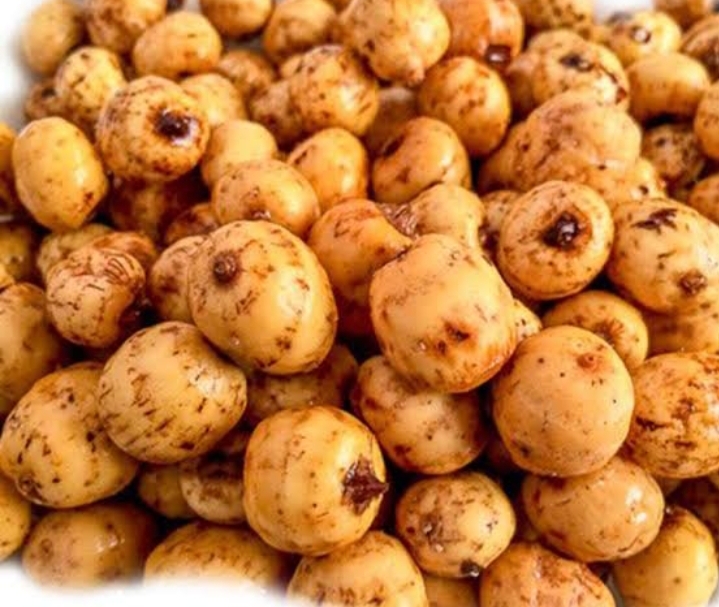
Tiger nut is actually a tuber plant, it doesn’t belong to the nuts family. This is contrary to the general, or I should say common knowledge. Tiger nut plant grows it’s tuber beneath the soil and isn’t enclosed in a pud like the groundnuts. Hence, it is a tuber plant.
The scientific name of Tiger nut is Cyprus esculentus. The plant is said to have originated from the ancient Egypt, but its cultivation and consumption has over the years spread to other African countries such as Nigeria, specifically in the northern part of the country. It has also spread across Europe, North and south America and even the Mediterranean. Each of these countries has native names they call tiger nut, for instance, in spain, it is called chufa.
Tiger nuts has a sweet almond-like or coconut-like taste and flavour. Research has shown that it exist in three varieties; brown, black and yellow. It can be eaten raw, cooked, roasted, dried, or juiced into tiger nut juice/drink, or the milk extracted and used for the Production of probiotic yoghurt as will be explained in this article.
Although the major focus of this article isn’t on the nutritional and health benefits of tiger nuts, but it is very important to point out some benefits.
Series of researches has shown that tiger nut possess the following nutritional qualities;
° It is rich in anti-oxidiants; Tiger nuts contains phenolic compounds which scarvenges and bind free Radicals that is responsible for the oxidative breakdown of body tissues.
° Has the tendency to reduce blood-glucose level.
° Improves Digestion. This it does through the various vitamins that it contain, especially the B-complexes.
° Improves heart Health: Tiger nut contains reasonable amount of mono-unsaturated fat which promotes heart health by lowering the amount of bad Cholesterol, which is the (L-D-C) low Density cholesterol, thereby reducing the risk of heart diseases.
There has also been reports that tiger nuts also functions as an aphrodisiac but this claim hasn’t been properly substantiated through a valid research. Therefore it is still based on speculations.
Having pointed out the nutritional benefits of tiger nuts, it is now time to get into the use of tiger nut milk to make probiotic yoghurt properly. There are different methods of extracting the milk from the tiger nuts, they are listed and explained below;
Method of extracting milk from the tiger nuts
1. Solvent extraction method ; This is the most common practice. In this method, the nuts are to be thoroughly washed and crushed using a blender or a mortar, thereafter, a reasonable quantity of water is to be added to the crushed particles, stirred vigorously for the water to properly mix with the tiger nut fluid. It should then be filtered using a wire mesh or a filter cloth. The milky liquid gotten should then be kept in a cool place or refrigerated pending when it will be used for the Yoghurt Production, this to avoid spoilage by microorganisms, heat or enzymatic activities. The residue (chaffs) can be dried and milled or used as animal feeds.
2. Hydraulic press method : In this method, a hydraulic press machine is to be used to crush and squeeze out the milky juices from the tiger nut which is to be collected over a container and then stored in the refrigerator pending when it will be used for the yoghurt Production. This method is more expensive because not everyone have such machine in their homes or can afford to buy it. But if you intend to go into commercial Production of this type of Yoghurt, then, this is the ideal method.
3. Reconstitution method; This method involves the use of tiger nut flour. I.e Tiger nut that has already being dried (sun dried, oven dried) or any other suitable drying method, then milled into powder. In this method, a certain quantity of the flour is to be measured out into a bowl and reasonable amount of water added and stirred vigorously using a spatula or spoon or wooden stirrer. Thereafter, the mixture is to be filtered using a filter cloth or wire mesh to get the milky liquid.
The ingredients and procedures for making Probiotic tiger nut yoghurt is almost the same with that of conventional yoghurt using milk from animals such as cow and goat except that it doesn’t really require pasteurization unless if there is suspicion of any microbial contaminants during the milk extraction stage. The ingredients are listed below:
Ingredients used for making probiotic yoghurt with tiger nut milk
1. 2 litres of Tiger nut milk.
2. Starter culture
3. 100g of sugar or syrup
4. 100g of Date fruit extract (optional)
Procedures for making Probiotic yoghurt with tiger nut milk.
¶ measure 2 litres of the tiger nut milk into a stainless pot, boil to a temperature of 40-42°C and bring it down. This is to raise the temperature of the medium to it’s optimum level so that the starter culture can act effectively.
¶ Transfer the milk quickly into a plastic bucket or bowl with cover, add a pinch of starter culture immdiately and cover it. This process is called inoculation . Take the bucket or bowl to a secluded spot with uniform temperature of not above 45°C
¶ Allow it to stay between 20-28hrs for fermentation to take place.
¶ Stop the fermentation process after that number of hours by using a stirrer or whisks to stir the yoghurt.
¶ Prepare and add 100g of sugar or syrup or date fruit extract and stir vigorously for proper mixture.
¶ sieve the Yoghurt to remove lumps or whey if any.
¶ package the Yoghurt into a plastic container or jugs and refrigerate before serving.

Probiotic yoghurt made with tiger nut milk is very special, it has some advantages over conventional yoghurts. These advantages are listed below:
Advantages of probiotic yoghurt made from tiger nut milk.
1. It is best for lactose Intolerant people: The amount of lactose in tiger nut milk is lower than that of cow or goat milk. so, it is more ideal for consumption to those who are allergic to cow or goat milk due to its lactose content.
2. It is Cheaper; cow or goat milk is actually very expensive when compared to tiger nut milk. So, one will definitely spend lesser amount of money preparing 1 litre of tiger nut yoghurt than preparing thesame quantity of Yoghurt with the conventional milk.
3. It is lesser in calories due to low amount of fats and carbs. Therefore it is more ideal for people who are putting their body calories level in check.
4. It is sufficient in Vitamins and minerals such as the B-complexes, Calcium, potassium etc just like the conventional yoghurts.
5. Tiger nut has been proven to possess anti oxidant and anti inflammatory Properties. Several studies has also shown that it boost the immune system and facilitates the synthesis of anti bodies. Therefore, by consumption of probiotic tiger nut yoghurt, one is sure to get these nutritional and health benefits. This is one big advantage that it has over conventional yoghurts.
There are also few disadvantages associated with this tiger nut yoghurt. Although it is insignificant, but It still has to be pointed out for the sake of clarity.
Disadvantages of Probiotic yoghurt made with tiger nut milk.
* The fermentation time is longer; Due to low amount of lactose which is the needed sugar for the activities of the starter culture. It takes longer time for the bacteria to convert available lactose in the milk into lactic acid which gives yoghurts the tart or sour taste unlike the cow milk which has sufficient amount of lactose.
* The Production process is more complex and tasking. This is because one would have to extract the milk from the Tiger nuts first through any of the three methods I had listed and explained earlier before starting the actual Production of the yoghurt. So it is time and energy consuming.
★ Summarily, Probiotic yoghurt made from tiger nut milk is very rich in nutrients and tastes absolutely nice. Those who are allergic to milk products from animal sources should consider this as the best alternative. Also, as it can be seen from my explanations above, there are even more nutritional and health benefits in Probiotic yoghurt than the ones made from cow milk.
 FoodsDoctorPro